Table of Contents
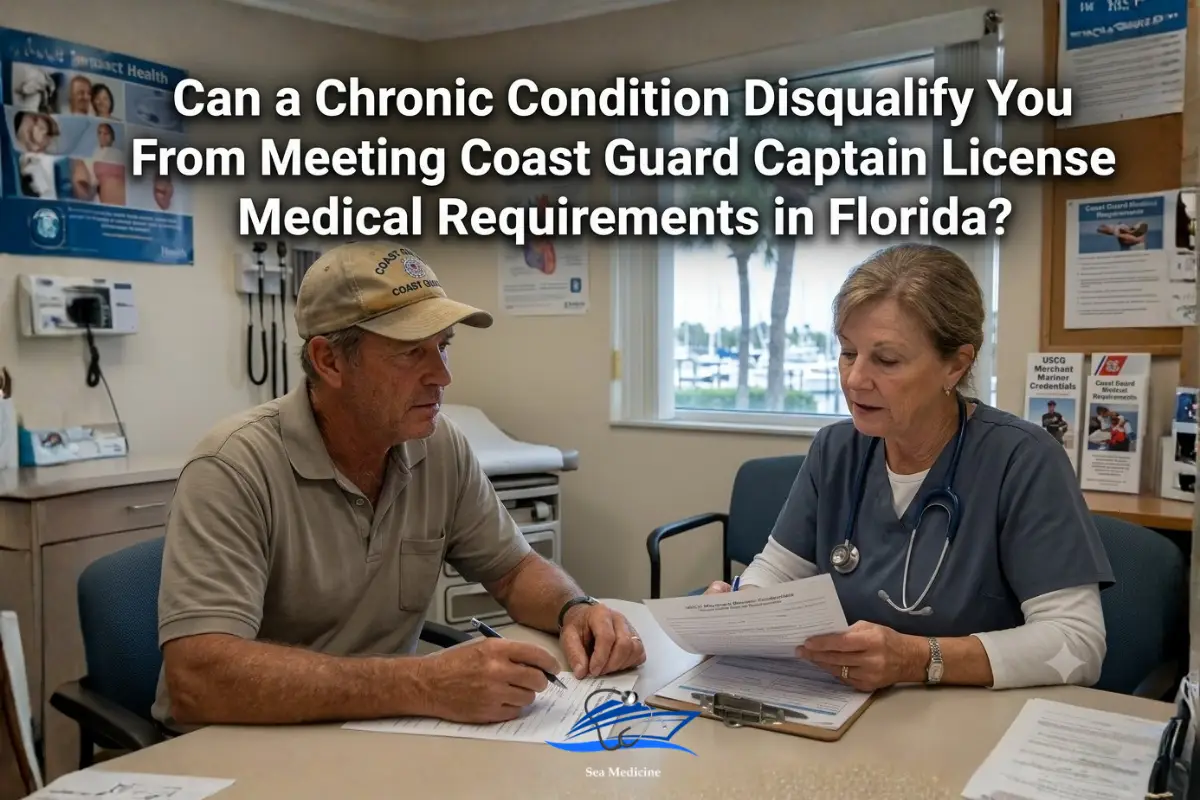
Summer is peak season on Florida’s waterways, and for a lot of people working toward their captain’s license right now, the medical exam is the one piece they’re most uncertain about. Not because they don’t know the process but because they have something in their medical history they’re not sure about. High blood pressure that’s been managed for years. Diabetes. A heart condition that’s stable but documented. Sleep apnea with a CPAP they’ve used faithfully.
The question they’re really asking is: does this disqualify me?
The honest answer is usually not. The Coast Guard captain license medical requirements in Florida are more nuanced than most people realize, and a chronic condition that’s well-managed and properly documented is a very different situation from the same condition that’s uncontrolled or undisclosed. This guide breaks down exactly how the USCG evaluates medical fitness, what kinds of conditions come up most often, and what actually determines whether you get cleared.
What the Coast Guard Captain License Medical Requirements in Florida Actually Evaluate
The medical exam for a Merchant Mariner Credential isn’t designed to exclude people with health histories. It’s designed to confirm that a mariner can safely perform the duties of their specific role without posing a risk to themselves, their passengers, or other vessels.
Learn more about How Long Is a US Coast Guard Physical Valid in Florida — know your renewal timeline before your certificate lapses
The OUPV License Physical Exam in Florida: Who It Applies To
The OUPV license commonly called the six-pack captain’s license, covers operators carrying up to six passengers for hire. It requires a medical certificate just like higher-tonnage credentials do.
- Vision meets requirements (corrected or uncorrected)
- Hearing is adequate for the role
- Cardiovascular status doesn’t pose an acute risk
- Any chronic conditions are stable and not likely to cause sudden incapacitation
- Medications don’t impair judgment or reaction time
Which Chronic Conditions Affect Your Florida Mariner Medical Clearance
| Condition | Automatically Disqualifying? | What Actually Matters |
| High blood pressure | No | Whether it’s controlled, on or off medication |
| Type 2 diabetes | No | Blood sugar control, HbA1c levels, medication type |
| Type 1 / insulin-dependent diabetes | More complex | May require additional documentation or waiver |
| Sleep apnea | No | Compliance with CPAP treatment, documented |
| Heart disease (stable, treated) | No | Cardiologist clearance, documented stability |
| History of heart attack | No, with caveats | Time since event, current cardiac function |
| Seizure disorder | Often disqualifying | Seizure-free period and specialist review required |
| Mental health history | Depends | Stability, treatment, type of condition |
| Vision problems | No if correctable | Must meet corrected vision standards |
| Hearing loss | No if aided | Must meet aided hearing standards |
Know more about How to Get Your USCG Merchant Mariner Medical Certificate in Florida — step by step, from exam to NMC submission
How Blood Pressure Is Handled Specifically
If your blood pressure is controlled to a reasonable range on the day of your exam and your physician can document that it’s been stable, this is generally not a barrier to six-pack captain medical clearance.
- Blood pressure that’s significantly elevated on exam day, even if usually controlled
- Medications that cause dizziness, drowsiness, or impaired reaction time
- A history of hypertensive crisis or related cardiac events without documented follow-up care
Mariner Fitness Standards in Clearwater FL: What Local Mariners Should Know
For mariners based in the Clearwater area and the broader Tampa Bay region, finding a physician experienced with mariner fitness standards in Clearwater, FL matters more than people realize. The USCG medical exam isn’t just a general physical — it requires a physician who understands the specific standards, knows how to document chronic conditions in a way the National Maritime Center can work with, and can flag potential issues before they become problems with your application.
A general practitioner doing their first mariner exam may not know that a certain medication needs to be specifically noted, or that a particular condition requires specialist clearance documentation. That gap in knowledge can delay your credential even when the underlying health situation is completely manageable.

Need Help Completing Your CG-719K Form?
A proper evaluation from an experienced mariner medical examiner gives you a clear answer –
not a guess.
How to Document a Chronic Condition for Your USCG Mariner Medical Exam
If you have a chronic condition that will come up during your exam, the cleaner your documentation is going in, the smoother the process runs. Here’s what typically helps:
- Current specialist letter — if you see a cardiologist, endocrinologist, or neurologist for the condition, a recent letter confirming stability and fitness for duty is valuable
- Lab results — HbA1c for diabetics, recent lipid panel, any relevant bloodwork your specialist ordered
- Medication list — complete name, dosage, prescribing reason, and how long you’ve been on it
- CPAP compliance report — if you treat sleep apnea, a downloaded compliance report from your device goes a long way
- Treatment history — showing consistent management over time, not just a recent cleanup before the exam
A Medical Examiner for Mariners familiar with USCG credentialing will know exactly what documentation the National Maritime Center expects to see and can help you assemble it properly rather than submitting something incomplete.
Why Full Disclosure Strengthens Your Coast Guard Captain License Medical Application
Yes. Always.
Applicants are required to provide complete and accurate medical information. The National Maritime Center may request additional records or documentation when needed to evaluate medical fitness. A condition disclosed and documented properly is almost always easier to handle than an undisclosed condition discovered later.
A Medical Examiner for Coast Guards who knows the NMC process will tell you the same thing: transparency combined with solid documentation is the strongest position you can be in, regardless of what’s in your history.
Learn more about the Complete Guide to Getting Your USCG Medical Certificate (CG-719K) in Florida — what the form requires and how to fill it out correctly
FAQs
What medical exam is required for a USCG captain's license in Florida?
Who can perform a Coast Guard captain's license medical exam in Florida?
Can I get an OUPV (six-pack) captain's license with high blood pressure?
How long does a USCG captain's license medical certificate last?
Get Your Exam Done Right the First Time
Sea Medicine, led by Dr. Auren Weinberg with over 25 years of medical experience, provides thorough, efficient mariner medical exams for Florida captains at all credential levels. Whether your medical history is straightforward or involves a condition you’re not sure how to handle, Dr. Weinberg understands the Coast Guard captain license medical requirements in Florida and will give you a clear, honest assessment.
📞 Contact Sea Medicine today to schedule your exam and get the answers you need before your application moves forward. Call us at (727) 648-2402 or email us at aweinberg@medavex.org