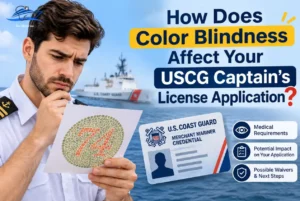
You’ve finished your sea service and you’re getting ready to apply for your captain’s license. Then the question creeps in: what if you’re color blind? Could that sink your application?
A color blind captain’s license application isn’t automatically rejected just because you have a color vision deficiency. There are Coast Guard vision requirements, which depend on the type of endorsement, the test results, and medical evaluations.
Let’s analyze what each requirement means, what tests should be taken, and what can be done if there are some problems with the initial testing process.
Can You Get a USCG Captain’s License If You Are Color Blind?
Color blindness is not always the determining factor. The Coast Guard will evaluate your compliance with color vision requirements and may also suggest alternative testing or a medical limitation.
A color blind merchant mariner may still have options, depending on the endorsement and their individual medical findings.
A captain’s license generally means a Merchant Mariner Credential (MMC) with a deck endorsement, such as Master or Mate. The National Maritime Center (NMC) makes the final medical qualification decision.
Why Does the Coast Guard Require Color Vision Testing for Mariners?
Color recognition matters a lot for safe vessel operation. Captains and Deck Officers should be able to see navigation lights, interpret visual signals, and comprehend color coding.
For instance:
- Red and Green Sidelights indicate the direction in which the other ship is moving.
- Buoys with different colors indicate channel borders.
- Visual Signals convey messages between ships.
- Navigation Lights will help maintain lookout while sailing at night.
A Physical Examination for Mariners includes vision checks because these abilities affect how safely someone can do their job onboard.
Under the Navigation Rules, vessels show red and green sidelights on their port and starboard sides. Recognizing those lights helps you read another vessel’s position and movement.
What Are the USCG Color Vision Requirements for a Captain’s License?
The coast guard color vision requirements are set out in 46 CFR 10.305. The standard that applies depends on the endorsement you’re seeking.
Color Vision Requirements for Deck Officers and Captains
Under the deck standard, you must show satisfactory color sense through an accepted screening test or an alternative test the Coast Guard accepts.
The visual acuity requirements are:
- Vision in at least one eye of at least 20/40 corrected.
- Vision in at least one eye of at least 20/200 uncorrected.
- Those applying for an STCW endorsement must satisfy these visual acuity criteria for both eyes.
A Physical Examination for Marine Captain includes separate checks for visual acuity and color vision. Passing the distance vision test doesn’t mean the color vision requirement has been met.
Are Color Vision Requirements Different for Engineering Endorsements?
Absolutely. The engineering officers, radio operators, tank vessels endorsements, and MODU applicants have another criterion of color vision.
They must be able to distinguish colors such as red, green, blue, and yellow. The criteria for their visual acuity are that their corrected vision should be 20/50 or better and that their uncorrected vision should be 20/200 or better in one eye.
The Coast Guard specifically accepts the Farnsworth D-15 Hue Test for this category.
Requirement | Deck endorsement | Engineering-related endorsement |
Color vision | Satisfactory color sense | Distinguish red, green, blue, and yellow |
Farnsworth D-15 | Alternative test subject to acceptance | Specifically accepted |
Correctable vision | 20/40 | 20/50 |
Which Color Vision Tests Are Accepted by the USCG?
Before taking a color vision test from the USCG, be sure to know which acceptable methods your medical provider is capable of using. They can be found in 46 CFR 10.305.
What Is the Ishihara Color Vision Test?
This color vision test involves plates of color dots that form numbers and patterns. It is useful for detecting certain deficiencies in color vision, especially red-green one.
The Coast Guard recognizes the 14-, 24-, and 38-plate editions. Passing criteria differ by edition, so the exact version matters.
What Other Color Vision Tests Can You Take?
Other accepted methods include:
- Dvorine Second Edition.
- AOC and AOC-HRR.
- HRR PIP Fourth Edition.
- Farnsworth Lantern.
- Titmus Vision Tester/OPTEC 2000.
- Optec 900.
- Richmond Second and Fourth Editions.
The Farnsworth lantern test is a common question for Coast Guard applicants, and it’s listed as an accepted deck screening method. Don’t mix it up with the Farnsworth D-15, which is specifically accepted for engineering-related endorsements.
How Many Errors Are Allowed on a USCG Color Vision Test?
Passing criteria depend on the test and edition.
Test | Passing criteria |
Ishihara 14-plate | 5 or fewer errors |
Ishihara 24-plate | 6 or fewer errors |
Ishihara 38-plate | 8 or fewer errors |
Dvorine Second Edition | 6 or fewer errors |
AOC (1965) | 6 or fewer errors on plates 1–15 |
AOC-HRR Second Edition | No errors on plates 7–11 |
HRR PIP Fourth Edition | No errors on plates 5–10 |
Richmond Second and Fourth Editions | 6 or fewer errors |
Titmus/OPTEC 2000 | No errors on six plates |
Other tests have their own scoring instructions. Your medical practitioner must record the test used and the actual results on your application.
Who Can Perform Your Coast Guard Color Vision Test?
The CG-719K application allows the vision assessment to be done by the medical practitioner, their medical staff, or another qualified practitioner. The healthcare professional must examine the results.
When selecting a Medical Examiner for Mariners, inquire if the clinic is familiar with Coast Guard medical certification and can handle the vision paperwork.
What Happens If You Fail the Coast Guard Color Vision Test?
Failing the initial screening is frustrating, especially after you’ve already put time and money into your maritime career. But an unsuccessful result doesn’t always end your application.
The Coast Guard may consider alternative testing. That can include a formal evaluation by an ophthalmologist or optometrist that provides:
The name of the test performed.
A description of the testing method.
Actual test results.
The specialist’s interpretation.
If you’re looking into a color vision waiver mariner option, know that approval isn’t automatic. The Coast Guard reviews your individual medical findings and decides whether alternative testing or a limitation is appropriate.
Don’t Let Medical Requirements Catch You Off Guard
Confused about how your color vision test results will impact your captain’s license? Sea Medicine, headed by Dr. Auren Weinberg, can assist sailors through Coast Guard physical exams and licensing standards.
Need more information? Contact us at (727) 648-2402!
Can You Get a Captain’s License With a Daylight-Only Restriction?
The Coast Guard’s Merchant Mariner Medical Manual describes a possible medical certificate limitation for certain deck applicants who can’t demonstrate satisfactory color vision:
No watchstanding or navigating at night or during periods of low or limited visibility.
This is what most applicants mean when they ask about a color blind captain’s license daytime restriction.
The restriction isn’t an automatic approval. The Coast Guard considers each application on its own.
Can You Work as a Captain With a Color Vision Restriction?
Possibly, depending on the medical limitation, the vessel, the route, and the job responsibilities.
- A daylight-only restriction may affect:
- Nighttime navigation.
- Night watchstanding.
- Operations during poor or limited visibility.
- The vessels and positions available to you.
A Marine Captain Medical Examiner will assist you with understanding your medical results and also the language in the restriction if one exists. It is up to the Coast Guard to issue the certificate, while your employer must decide if your particular job qualifies for the certificate.
What Happens If the NMC Denies Your Medical Certification?
If the NMC rejects your medical certification, you have the option of requesting a reconsideration on the website.
This must usually be done within 30 days of the rejection. In case the reconsideration is rejected, you may appeal officially within 30 days after the reconsideration. Include relevant medical records and supporting information.
Can Color-Correcting Glasses Help You Pass the Coast Guard Color Vision Test?
No. The Coast Guard doesn’t allow color-sensing or color-enhancing lenses to meet its color vision standard.
Ordinary prescription glasses are different. They can help you meet visual acuity requirements when appropriate, but they can’t replace the color vision exam.
If you’re looking into mariner eye exam requirements Florida, the same federal Coast Guard vision standards apply in Florida as anywhere else. What matters most is getting tested by a provider who knows the accepted methods.
What Color Vision Documents Should You Submit With Your USCG Application?
The Coast Guard needs objective, documented test results. A general statement that you can identify colors won’t cut it.
Your documentation may include:
- A completed CG-719K medical application.
- Results from an accepted color vision test.
- The test name and edition.
- The actual number of errors.
- An ophthalmology or optometry report if you submit alternative testing.
During your First Merchant Mariner Physical Exam, make sure your provider records the vision findings accurately. The current CG-719K also covers medical history, hearing, general physical exam, and physical ability.
Another requirement to keep in mind is Drug Testing for Mariners. For applicable credential transactions, the NMC accepts approved drug-test results, qualifying random-testing-program letters, or qualifying pre-employment testing letters. These are separate from color vision testing.
Can You Renew Your Captain’s License If You Have Color Vision Deficiency?
Yes, but renewal applicants have a few extra things to consider.
If you previously passed color vision screening and operated without a credential limitation but now fail a later test, the Coast Guard’s Medical Manual recommends submitting a formal ophthalmology evaluation.
If that evaluation supports a mild color vision deficiency without significant functional impairment, a waiver may be considered. You may also be asked to demonstrate color-critical tasks in practice.
If you pass that demonstration, you may be considered for a medical certificate limited to the vessel and route you tested on. Approval isn’t guaranteed.
For renewals, check Drug Testing for Marine Captain requirements separately against the applicable NMC transaction checklist. A color vision assessment doesn’t replace drug-testing documentation when it’s required.
What Should You Do Before Submitting Your USCG Captain’s License Application?
Little preparations can save time from going through unnecessary problems.
- Identify your endorsement: Determine what you are applying for, either Master, Mate, OUPV, or other endorsements.
- Determine the vision standard: Find out the specific standard under 46 CFR 10.305.
- Locate the appropriate facility: Inquire if the clinic provides an acceptable color vision test.
- Identify the test version: Make sure that you know what test is administered.
- Document your result: Make sure to have the written results of your examination.
- Discuss alternatives: Contact the NMC for guidance if you don’t meet the initial screening standard.
- Review your application: Check that the medical documentation is complete before you submit it.
Do I Need a New Physical to Upgrade My Captain’s License?
Not necessarily. Under 46 CFR 10.301(c), applicants seeking an additional MMC endorsement don’t need a new medical physical if their existing medical certificate is current and meets all the requirements for the endorsement they want.
If the existing certificate doesn’t meet those requirements or has expired, you may need additional medical documentation or a new exam.
Conclusion: Understand Your Color Vision Requirements Before Applying
Color vision deficiency doesn’t automatically decide your future as a captain. Your approval, the test results, and your medical restrictions all make an impact.
Make sure to get the right examination, keep your medical records, and know your rights prior to applying.
Sea Medicine, run by Dr. Auren Weinberg, conducts Coast Guard examinations and educates mariners about the need for medical certification. They also help conduct the necessary examinations and provide necessary documentation.
Need guidance with your Coast Guard medical examination? Contact Sea Medicine at (727) 648-2402 or aweinberg@medavex.org to discuss your next steps.
FAQs
Can You Get a USCG Captain’s License If You Are Color Blind?
Possibly. You have to meet the applicable color vision standard, or get Coast Guard acceptance of an alternative evaluation or medical limitation.
What Happens If You Fail the Coast Guard Color Vision Test?
How Many Ishihara Errors Are Allowed for a USCG Captain’s License?
Can You Use the Farnsworth D-15 Test for a Captain’s License?
It’s specifically accepted for engineering-related endorsements. Deck applicants can submit it as an alternative, but the Coast Guard has to accept it.
Can Color-Blind Mariners Receive a Daylight-Only Restriction?
A few candidates applying to be on deck might qualify for restrictions in the night watch or navigation during poor visibility. This depends on the situation.